.png)
Kilometers & Kilograms; Measurement & Meaning.

Updated: Aug 9, 2025
08.08.2025 Kilometers, Kilograms & Clicks: Measurement, Motivation & Meaning.
In today’s article I want to talk about the training process, and more specifically the double-edged sword of measurement. I delve into my fitness journey and how I continue to face the balance in using measurements to sustain motivation, but the far deeper intrinsic motivation which derives from finding meaning in the journey. There are two sides to measurement. On one side, measurement is incredibly useful. With it we can track progress, set goals, and describe our accomplishments with numerical facts. On the other hand, relying solely on measurement can leave us in the comparison trap, it cannot fully describe the quality of our progress, nor can it do justice to the emotional side of human experience. Through my journey I have strategically used both measurement and more abstract or creative means of progress tracking to maintain my vision no matter what the setbacks. Though I have a long road ahead of me, I have been committed to my journey with a consistent drive and genuine confidence that it will all work out. My experiences with tools for personal growth were introduced to me through mental healthcare professionals, industry leading trainers and modern research on psychology. Here we go!
We can track progress with health apps, journals, certifications, and by taking on ever more challenging adventures.
Measuring Makes (and Maintains) Motivation. Whenever I want to take on a new project I set goals for myself to work towards. By having clearly defined outcomes, we stop shooting in the dark. If we set a large goal such as ‘I want to train my dog to be a service dog’, especially if it’s a totally new endeavor, then we have a long list of uncertainties which can be terrifying. Its important to break down these large and often abstract goals into measurable bits that can be feasibly achieved. For example, I did not just train Spirit to be a service dog. Once I committed to that journey, there were many measurements of success, or milestones, I set for us as a team. First, I defined service dog by the tasks she would perform, the skills she would need for public access, and then further broke those down. Let’s take the public access portion. For navigating the public sphere, we would need the following skills:

1. Able to heel on leash all day, often for an hour at a time.
2. Settle on one spot for several hours at a time and hold a down stay at a distance for at least 30 minutes – an hour.
3. Sit/lay down calmly without barking around people, children, wheelchairs, dogs, crowds, and more.
4. Go through doorways calmly.
5. Calmly go up and down stairs, escalators, and elevators.
6. Calmly ride in taxis, Ubers, trains, planes, buses, and subways.
7. Be able to perform all of this without reliance on either treats nor under the threat of punishment.
Even these goals are daunting. To make it palatable, I set time bound goals into each exercise. For now, let’s focus on one: Settling in a down stay. I set the ultimate goal at 2 hours to consider her ‘fully trained’. Here ‘fully trained’ meant that she could reliably perform a 2 hour settled down-stay without needing treats or crying in public. I chose this framework because it is sufficient for the length of most activities we would encounter such as eating at a restaurant, seeing a movie in theaters, a long bus ride, studying, going to lectures… you get the idea. We started training this behavior the day Spirit came home at 8 weeks old. Maintaining a settled down stay has three major components:
1. Reliably moving into the down position.
2. Staying in the desired position.
3. Relaxing in the desired position
Each of these parameters was started separately. It took thousands of clicks to form the finished behavior (a click is how we mark a good behavior in dog training). Moving in the down position was mastered with small measurable goals over the course of years. Now, Spirit can lie down whether she is running off leash, approaching birds, sitting, standing, playing, on or off leash. Even if my hands are full or she cannot see me I still trust that our training holds up.
Whether on the trails, at the court, or pointing at a flock of birds, I need to trust that Spirit can hold a down stay. Measuring progress allows us to track skill development, but overcoming challenging environments is meaningful in its own way.
Relaxing in the down position was treated similarly with tether training, crate training, and putting her periods of rest on cue – she knows that when a blanket comes out or I ask her to go lay down, that we are going to be there for a while. This is different than staying. Staying implies impulse control – that even if she is in a high state of energy such as in the middle of a run or while playing fetch, that she can remain in a down stay. From day one, I started building on these behaviors by setting measurable parameters for what each session would look like. The first week looked something like this:
Age: | Physical behavior | Time Measurement | Distractions | Time worked on at once | Time worked on per day |
8 weeks | Move from a stand to a down. | 1 second. | None. | 30 seconds. | 3 minutes. |
8 weeks | Go to a blanket | 1 second. | None. | 30 seconds. | 3 minutes. |
8 weeks | Settle on a blanket while tethered. | 10 minutes. | None. Plus given kong toys and meals on blanket after exercise. | 10 minutes | 30 minutes. |
8 weeks. | Settle in a crate while traveling or at home. | 10 -45 minutes | None. Plus given meals and Kong toys in crate. | 10-45 minutes | 6 hours. |
Over the course of a year or two, each parameter became increasingly complex. Taking just the action of moving into the ‘down’ position, an 18-month progress chart looks something like this. Each of the three parameters would have a similar progression and individual training sessions would realistically start combining concepts as she mastered each step.
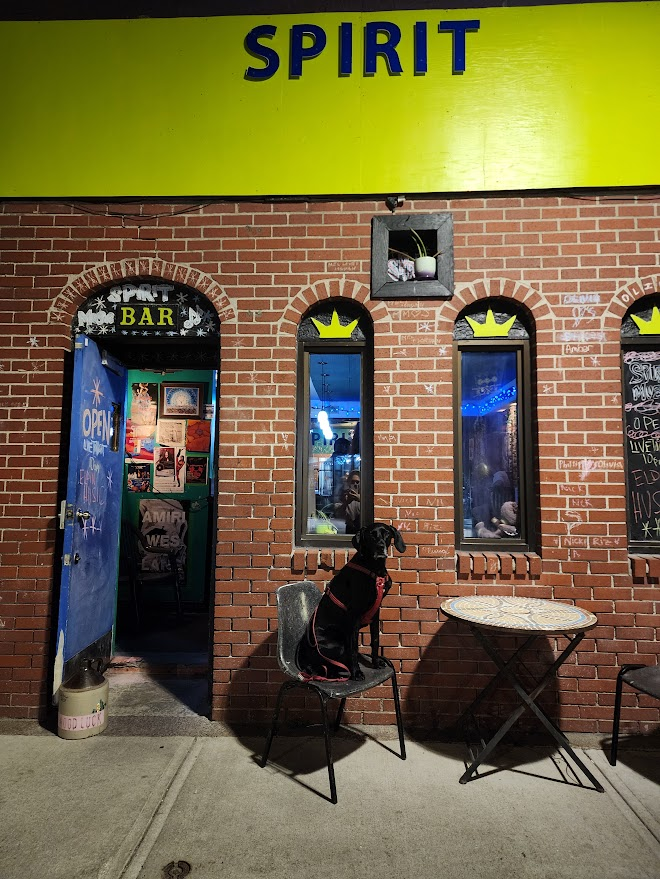
Even Spirit's fashion-wearing abilities and diva qualities were honed with years of experimentation.
Base Behavior: Moving into a down. |
| ||||
Age: | Physical Complexity | Time in Physical State | Distractions | Length of Session | Time Worked on Per Day |
8 Weeks (Start) | Moving from a stand to a down | 1 second | None. | 30 Seconds. | 2 Minutes. |
9 Weeks | Moving from a stand or sit into a down, and back into either a sit or down | 2 seconds | Other dog and cat in room | 30 seconds. | 4 minutes. |
10 Weeks | Holding the down position before transition to another. | 5 seconds. | Other dog and cat in room. Food dropped on the floor. | 1 minute. | 3 minutes. |
11 weeks. | Holding the down position | 15 seconds | None. | 5 minutes. | 5 minutes |
12 weeks | Responding to the hand signal without treats in hand | 0.5 seconds | None. | 1 minute | 2 minutes |
13 weeks | Moving from a sit into a down and back into either a sit or down, without treats in the hand | 0.5 seconds | None. | 1 minute. | 2 minutes |
14 weeks | Holding the down position | 30 seconds | None. Plus fed treats every 1-5 seconds | 5 minutes | 15 minutes |
6 months | Repeating Lessons from foundations in new environments | 1 second – 1 minutes | Many | 20 | 1.5 hours |
7 months | Moving into the down position with only a verbal cue | Variable. | None. | 2 minutes. | 6 minutes. |
1 year | Moving into the down position while in motion, on leash | 0.5 seconds | Dog is in motion at home. | 5 minutes. | 10 minutes |
1.5 years | Moving into the down position in motion in public. | 0.5 seconds – 30 seconds | Dog is in motion with normal public distractions. Dog is fed every second when holding position | 2 minutes | 10 minutes. |
Same dog, same blanky - but more teddy bears. Spirit is very skilled at relaxing!
Going back to how measurement and motivation go together, setting small increments kept us on track as a team. More than that, let’s say we went out to a mall to train with friends who had adult dogs; If Spirit was unable to hold a down stay as well as them it did not reflect her potential nor her quality as a long-term canine partner. Her performance matched our progress. She could not hold a down stay as well as the other dogs because we were not there yet! We were still working on step 2, but those dogs were on step 10. Today Spirit performs as a service dog must. By measuring progress and focusing on where we are at, not were we ‘should’ be, I was able to trust the process of reward-based training.
This kind of training relies on patience and successive approximation. When I fell into the comparison trap (that feeling that Spirit and I were not measuring up to the competition) I became meaner, less patient, and less fair to myself and her – something that I never want to be again. Spirit was a fantastic puppy and is a fantastic dog. I am so proud of all the things we can do together. Looking back, that entire learning process was so special, never again will I doubt that process. We need to measure our successes and cherish the journey. In this way, measurement allows us to continuously build motivation.
Motivation drives even deeper when it is fueled by meaning. It can be tempting to become obsessed with the measurements, but they are sometimes shallow. Along our journey there were times when the numbers simply could not show the magical transformation happening at the deepest levels. It was the moments of quiet observation which revealed our true accomplishments. When I noticed how we were friendly and welcoming, that I had let go of defensiveness or social anxiety or when I regained the confidence to pursue new things I felt that we had accomplished something worthy of pride. When I stepped foot on the trails again after months of hiding in the shadows I owed myself real celebration. When I trusted Spirit or when I was forgiving of errors I knew I was becoming the person I was meant to be. Day by day my journals started reflecting a person who led with joy. The numbers may tell you what page you’re on, but they don’t tell you the story. The story of The Girl and Her Spirit Dog comes to life when we skip through meadows, lift a friend up, or look in the mirror and see a beautiful person looking back.
Measuring the numbers allowed me to set parameters for our training. It gave solid frameworks to build towards and work within. It set the blueprint for motivation, but underneath the numbers there was something much deeper in play: The meaning behind what we were doing. We worked hard on each aspect of training because doing so meant that Spirit and I could be a team. That hard work gave us both freedom. Spirit is now protected by higher animal rights laws because of her service dog status. Having her as my partner allows me to shine. Together we overcome challenges, struggles and the darkest days of life. I was not just motivated by the measuring stick – I was motivated because our success means living the life of my dreams. I now have freedom from my own demons, freedom to travel the world with my Spirit Dog, freedom from my own limiting beliefs, and most of all the freedom to know that the truest form of love comes from unwavering devotion to grow together.
In the fitness journey aspect of my recovery I have also measured my success through numbered kilometers. I worked my way up from walking down the street to running 20 km and hiking 336km. I measured my success in kilograms too. Every time I stepped on a scale I would compare myself to a vision of perfection (often with a lot of shame and self hatred, if I'm being honest). In the gym, I would measure my strength based off of how many kilograms I could lift. There is a certain satisfaction in seeing the scale shift as my ability to lift goes up. I am incredibly proud of the kilometers under my feet and the kilograms lifted above my body. However, there is so much more. Strength is not just how heavy I can bench - its also my ability to show up even when I'm afraid or demotivated. Success is also being present for a friend when they need a person to talk to. As I've gotten healthier, the numbers are not the only thing that changed - it was my character that changed too.
While the weights go up, my true transformation and strength shines in the way I hold myself: with confidence and unwavering belief in myself.
Recognizing the emotional reality of progress cuts deeper than the numbers. It acknowledges a transformation beyond the surface where our stories come alive with meaning. When I start to fear the world, I bring myself back to my meaning: the why behind what I’m doing. We measure 'what' we do: Spirit can lie down in high distraction for 2 hours. Why can she do this? She can do this because we have an unbreakable bond; because we put in countless hours; because I trusted the process. Why did I do that? Because I believed that becoming a service dog team would save my life – and it did. My deepest meaning is that I want to live a life of love, joy, optimism, humility, and kindness. My meanings are my values:
Knowledge
Progress
Kindness
Effort
Determination
Faith
Togetherness
Love
Strength
Gentleness
Inclusiveness
Understanding
Empathy
Forgiveness
Empowerment
Peace
Loyalty
And finally, I believe that our potential is greater than our current position.
Beyond the physical gains, the healthier I've become, the more friends I've met along the way. I've become a social butterfly. Once I was afraid to be in photos, but now I'm the one saying 'we should take a picture!'.
Our trajectory can change with the right impact. It’s simple physics. So, when you measure yourself up and consider your own motivation, dig a little bit deeper. Ask yourself for more than just a measurement, but for a meaning too. Maybe you go to the gym because you want to play with your grandchildren because you value family. Perhaps you go hiking because it means unity with nature or play music because to you it means expression. Next time you look at what page you’re on – how many pushups you can do, the grade you climb, how well your dog can stay, or what you weigh – please do remember to tell the world your story too. After all this is your life, and only you can write your story for you.
With 25 years filled with stories and a spirit that can never be measured,
- Julia & Spirit


Comments